
Species guide — Gulf Coast specialty
Armadillo Removal in Mobile, AL
Quick answer
Cost figures compiled from national cost data and published local pricing, September 2026. Every job is quoted after an inspection — treat these ranges as orientation, not a bid.
Talk to a local wildlife specialist now
Serving Mobile, Baldwin County and Pensacola — describe what’s going on and get matched by phone.
Call (251) 486-467124/7 — speak with a local specialist now.
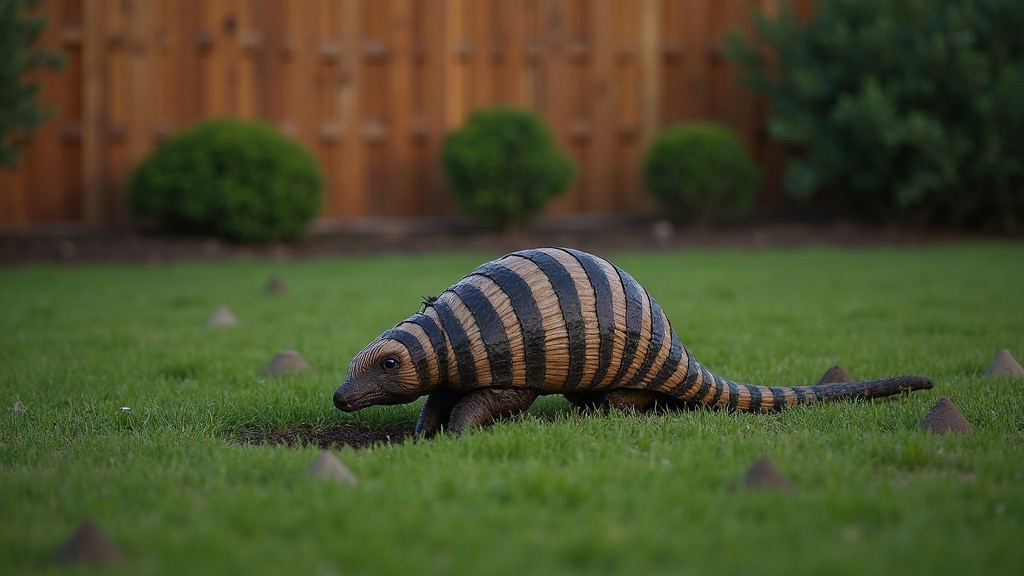
Why armadillos are tearing up your yard
The nine-banded armadillo is now firmly established across south Alabama and the Florida panhandle — our mild, wet winters and soft, grub-rich Gulf Coast soil suit it perfectly. The damage comes in two forms:
- Feeding digs — dozens of shallow, conical holes (1–3 inches deep) across the lawn overnight as the animal probes for grubs and earthworms. Fresh sod and irrigated beds get hit hardest because that's where the grubs are.
- Burrows — the serious one. A den burrow runs several feet long under slabs, porches, AC condenser pads, driveways and even home foundations, and can crack concrete or void a termite bond when soil gets excavated from under the slab edge.
Armadillos have almost no natural predators here and females produce identical quadruplets every spring, so a yard problem rarely stays a one-armadillo problem.
How professional armadillo removal works
- Locate the burrow and travel paths — armadillos are creatures of habit and run the same fence lines nightly.
- Set live traps on those paths, usually with natural funneling (boards or existing fencing) guiding the animal in. Armadillos don't respond to bait the way raccoons do, so trap placement is the whole game — this is where DIY attempts usually fail.
- Remove and relocate or dispatch per Alabama/Florida rules — in Florida, nuisance armadillos generally can't be relocated off-property and must be humanely euthanized; your operator handles the legal side.
- Fill and collapse the burrow so the void under the slab doesn't settle, and address the grub load in the lawn if it's drawing repeat visitors.
What armadillo removal costs
- Trapping setup + first animal: roughly $150–$350.
- Multiple animals or extended trapping: roughly $300–$500.
- Burrow remediation / slab repair: quoted separately; minor fill work is cheap, concrete repair is a contractor job.
Compare with other species on the cost page, and find companies that list armadillo work — not all do — in the Gulf Coast directory.
Keeping armadillos out for good
There's no registered repellent that reliably moves armadillos, and shooting them is illegal inside Mobile and Pensacola city limits (and most subdivisions). What works:
- Low fencing — armadillos are poor climbers; a 2-foot fence angled outward at the top protects beds and slab edges.
- Grub management — treating heavy grub infestations makes the lawn less attractive, though earthworms will still bring some digging.
- Removing cover — dense ground cover, brush piles and overgrown fence lines are prime burrow habitat.
- Fast trapping when digging starts — a new armadillo hasn't built its burrow network yet. Two weeks of digging is a lawn problem; two months is a foundation problem.
FAQ
Frequently asked questions
Do armadillos carry leprosy?
Nine-banded armadillos can carry Mycobacterium leprae, and they're the one wild animal known to transmit leprosy (Hansen's disease) to humans — but cases are rare and linked to handling or eating armadillos, not to sharing a yard with one. The practical rule: don't handle them, keep pets from mouthing them, and let the trapper do the touching.
Will mothballs or repellents get rid of armadillos?
No. Armadillos don't forage by smell the way repellents assume, and no product is registered as an effective armadillo repellent. Trapping on their travel paths is the only reliable removal method.
Can an armadillo burrow really damage my foundation?
Yes — indirectly. The burrow itself doesn't eat concrete, but excavating several cubic feet of soil from under a slab edge, AC pad or driveway lets the concrete settle and crack. Burrows near the foundation can also void a termite bond by disturbing the treated soil barrier. Fill burrows promptly after removal.
Why do I keep getting armadillos every summer?
Irrigated, grub-rich lawns are armadillo magnets, and each female produces four identical offspring every spring — usually in April through July on the Gulf Coast. If your neighbors have armadillos, you will too. Annual trapping plus grub management keeps it manageable.
Is it legal to trap armadillos myself in Alabama or Florida?
Homeowners can generally trap nuisance armadillos on their own property, but disposal rules differ: Florida treats armadillos as non-native and generally prohibits relocating them off your property (they must be humanely euthanized), while Alabama has its own nuisance wildlife rules. A DCNR-permitted NWCO in Alabama — or an FWC-compliant trapper in Florida — handles this for you.
Ready to get the animal out — and keep it out?
Call now — speak with a local wildlife specialist serving Mobile, Baldwin County and Pensacola. 24/7.