
Species guide — Gulf Coast
Bat Removal in Mobile & the Gulf Coast
Quick answer
Cost figures compiled from national cost data and published local pricing, September 2026. Every job is quoted after an inspection — treat these ranges as orientation, not a bid.
Talk to a local wildlife specialist now
Serving Mobile, Baldwin County and Pensacola — describe what’s going on and get matched by phone.
Call (251) 486-467124/7 — speak with a local specialist now.
Signs of bats in the attic
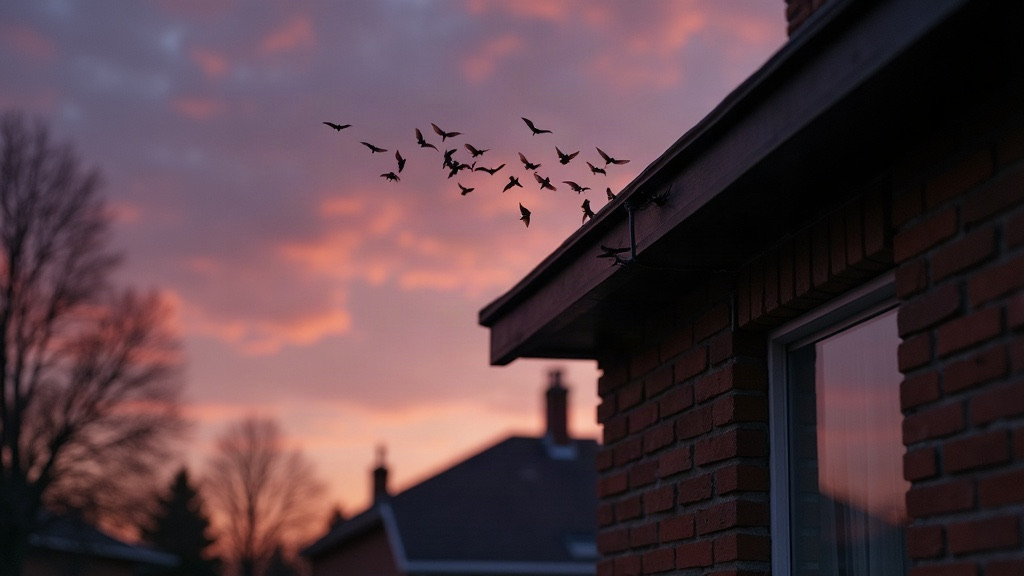
- Bats swirling near the roofline at dusk — the clearest sign; watch your eaves 15 minutes after sunset.
- Guano — small dark pellets that crumble to powder, collecting on porches, window sills or below a gap in the fascia. Never confuse it with mouse droppings: guano sparkles with insect parts.
- High-pitched chirping at dusk and dawn from walls or the attic.
- Brown staining around a thumb-sized gap — body oils mark the entry they use nightly.
- Ammonia smell in the attic from accumulated urine and guano.
Mexican free-tailed bats are the usual colonists in Mobile and Pensacola attics; a single gap of half an inch is all they need.
Maternity season: the April–August rule
From spring into late summer, female bats gather in maternity colonies and give birth to pups that can't fly until roughly August. Sealing the exits during that window doesn't remove the colony — it traps flightless pups inside to die, and drives frantic mothers into your living space looking for another way in.
Florida codifies this: bat exclusions are generally prohibited from mid-April through mid-August without special authorization from the FWC. Alabama doesn't set the same fixed dates, but DCNR-permitted operators follow the same biological window. A reputable company will still inspect and seal everything except the active entries during maternity season, then install the one-way valves once the pups can fly — usually from late August into fall, the ideal season for bat work on the Gulf Coast.
How bat exclusion works
- Full inspection — every gap from foundation to ridge, because bats use multiple entries and will simply shift to the next opening.
- Seal the secondary gaps — caulk, flashing and screening on everything except the active entries.
- Install one-way exclusion devices — bat valves or netting over the active entries. Bats leave to feed and can't get back in.
- Wait 5–7 nights (weather permitting), confirm the attic is empty, then remove the devices and seal the final gaps.
- Guano cleanup — droppings can harbor Histoplasma spores, so heavy accumulations need professional removal with respirators, and sometimes partial insulation replacement.
Bats are protected and enormously beneficial — a colony eats thousands of mosquitoes a night. Exclusion is about moving them out of your attic, not harming them.
What bat removal costs
- Inspection: often free with the job, or $100–$200.
- Small, single-entry exclusion: roughly $300–$700.
- Whole-house bat-proofing, established colony: commonly $1,500–$5,000 depending on roofline complexity.
- Guano cleanup / attic restoration: quoted separately, from a few hundred dollars to several thousand for heavy contamination.
More detail on our cost page. Compare companies with bat experience — it is a specialty — in the Gulf Coast directory.
FAQ
Frequently asked questions
Can I remove bats during the summer?
Not properly. During maternity season (roughly April through August) the pups can't fly, so one-way doors would separate mothers from their young. Florida restricts exclusions outright from mid-April to mid-August. What a pro can do in summer: inspect, quote, seal all non-active gaps, and schedule the final exclusion for late August or fall.
Are bats in Alabama and Florida protected?
Yes. Bats are not classified as unprotected vermin — they're regulated wildlife, and some species have federal protections. That's why killing a colony is both illegal-adjacent and ineffective; exclusion is the only method reputable NWCO-permitted operators use.
Is bat guano dangerous?
It can be. Accumulated guano can harbor Histoplasma capsulatum spores, which cause the lung infection histoplasmosis when disturbed dust is inhaled. Small amounts on a porch are low risk; attic accumulations should be removed by a crew with respirators. Bats are also a rabies-vector species, so a bat found in a living space — especially a bedroom — warrants a call to your county health department about testing.
Why do bats keep coming back to the same house?
Bats have strong roost fidelity — a colony will return to the same attic for years, and the scent of a previous colony attracts new ones. That's why sealing every quarter-inch gap (not just the one they're using tonight) is the core of the job.
How long does a full bat exclusion take?
The hands-on work is usually one to three days; the one-way devices then stay up for about a week so every bat leaves on its own schedule. Add a follow-up visit to remove devices and seal the final entries. Outside maternity season, plan on two to three weeks start to finish.
Ready to get the animal out — and keep it out?
Call now — speak with a local wildlife specialist serving Mobile, Baldwin County and Pensacola. 24/7.